6 Signs Your Mahjong Set Is Not Ready for American Mahjong
In short. A beautiful mahjong set is not automatically ready for American mahjong. The clearest sign is no jokers in the case, which points to a Chinese tile mix that cannot support card play. Check readability next, because suits and winds that are hard to identify from the far seat slow every turn, and turn every tile face down to look for damage that makes a tile recognizable. The last readiness check is the current annual card, which no equipment purchase supplies.
A beautiful mahjong set is not automatically ready for American mahjong. The game needs a suitable tile mix, readable markings and a table setup that supports racks, walls and the current annual card. A quick inspection can separate a small missing accessory from a true ruleset mismatch. If any of these six signs appears, identify the exact problem before replacing the entire set.
Along the way, we look at the sets that get inherited or bought, the questions worth asking before a first game and the checks worth making once the tiles are on the table.
- There are no jokers in the set
- The suits and winds are difficult to identify
- The tile breakdown is unknown or incomplete
- The racks do not fit the tiles
- Damage makes some tiles recognizable
- The table has no current annual card
1. There are no jokers in the set
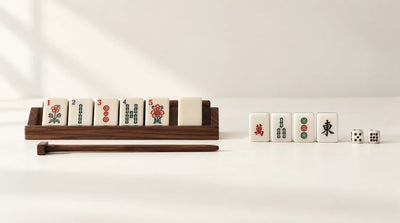
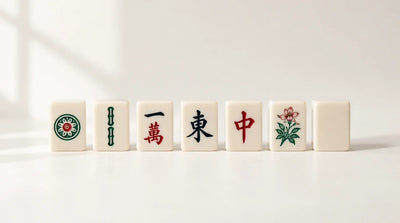
A traditional Chinese set may contain suits, winds, dragons, flowers and seasons but no jokers. That can be correct for the rules it was designed to support, yet it leaves the set incomplete for American card play. Do not treat the absence as a manufacturing error. First confirm the set's variant and original tile layout, because adding unrelated replacement tiles can create mismatched backs that reveal information during a game.
For American mahjong, choose a set whose listing clearly states its joker count and shows the backs as well as the faces. Loose jokers are useful only when their size, thickness, material and back pattern match closely enough to remain indistinguishable. If they do not, replacing the tile group is more practical than building a set that can be read from the wall.
From the table: a treasured Chinese set can be brought to an American table, but it takes some homework. The first search is for jokers or blanks that match the size and look of the original tiles. A set with no jokers will not play, and that gap often only becomes clear at a class where the teaching set has them.

Classic Mahjong Set - Ochre
$70.99
A 144-tile Chinese set with traditional markings, flowers and seasons, designed for Chinese play.
2. The suits and winds are difficult to identify
American players scan the card and the rack repeatedly, so readable suit numbers and wind letters can make a substantial difference. A set without corner indices may be perfectly suitable for an experienced Chinese group but frustrating for a beginner learning American terms. Test visibility from the far seat in ordinary room light. Close product photography does not reproduce the distance or viewing angle of a four-player table.
Look for consistent contrast and enough space between the corner index and the main artwork. A decorative face should not make a seven look like a one or hide the direction of a wind. If only one player struggles, better lighting or a larger card may solve part of the problem. If everyone leans over the table, the set is not serving the group well.
From the table: flowers and seasons vary widely from one antique set to another. Identifying each one takes a close look, since the same flower or season can look nothing like the version in another set. Even an experienced player heading to a tournament can need a reminder of which tiles represent the flowers in a traditional set.

American Mahjong Set 166 Tiles - Bluebell
$172.99
A 166-tile American set with corner numbers and lettered winds for easier identification.
3. The tile breakdown is unknown or incomplete
A total written on the case is not enough. Count the numbered suits, winds, dragons, flowers, jokers and blanks separately, then note any duplicates or substitutions. A secondhand set may have absorbed tiles from another box over many years. Matching faces with slightly different backs are also a problem, because a player can learn which category is coming before a tile is turned.
Compare your count with the maker's stated American layout and the requirements of the group. American sets are sold with different totals, so the answer is not simply that one number is always valid. What matters is a deliberate, usable composition with the needed jokers and no accidental markers. Keep the count in the case so the next seasonal inspection takes minutes rather than an evening.
From the table: sorting a set by suit is the quickest way to check that every tile is there. A first set often turns up blanks, an extra joker or a few pieces that are hard to place, and those are worth identifying before the first game.
4. The racks do not fit the tiles
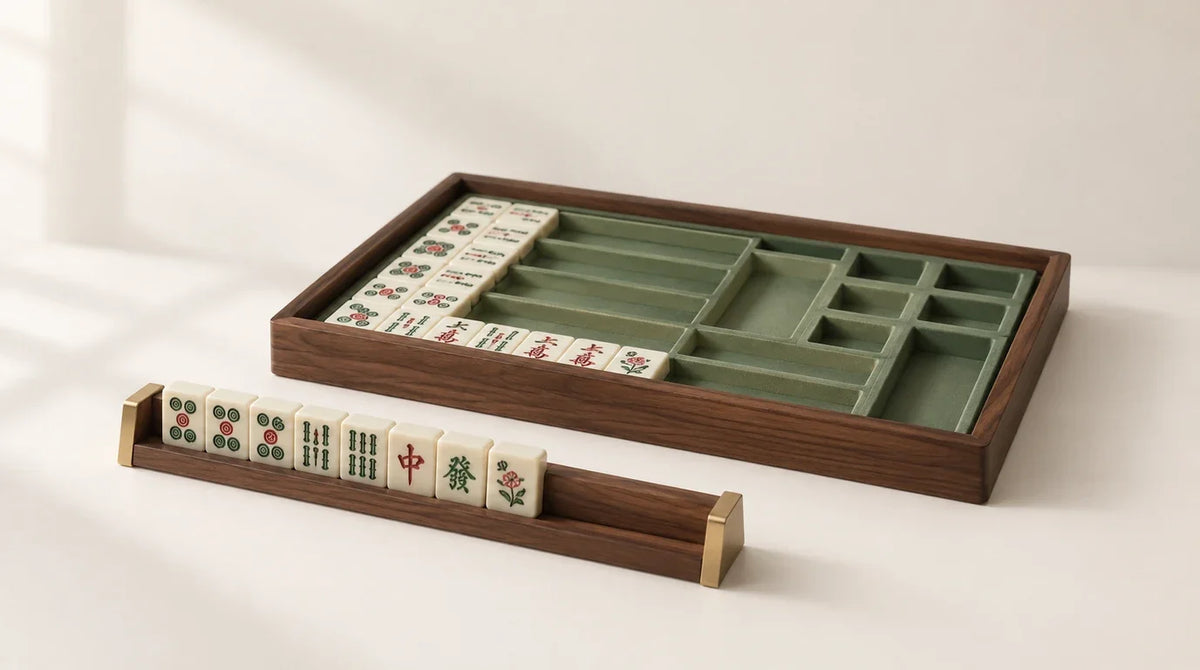
A rack can be too narrow, too shallow or too steep even when it looks correct beside the set. Place a full hand in the channel and check whether every tile stands without leaning. The lower markings should remain visible, and the rack should have enough length to organize the hand without stacking pieces. Then build and move a wall to see whether the pusher stays stable.
Mixed equipment often causes this problem. A case may contain tiles from one maker and short racks from another, or Chinese-size tiles may sit loosely in a channel intended for larger American pieces. Measure both before ordering replacements. Four compatible racks are more useful than four attractive ones, and a pusher should move the wall without forcing a player to reach across the table.
From the table: fit questions can come up before the plastic is even off. Checking whether the tiles are standard size before unwrapping a new set is smart, since rack channels are made for particular tile sizes. A set bought as a gift also needs a pusher and a mat to go with it.

Mahjong Racks with Pushers - Larch
From $96.99
Four 18.5-inch racks with built-in pushers for an American mahjong setup.
5. Damage makes some tiles recognizable
Turn every tile face down and examine the backs as a single field. A deep scratch, faded corner, different shade or warped edge can reveal a tile before it is drawn. Minor wear that appears evenly across the set is less concerning than one distinctive mark. Clean only according to the material's care instructions, since strong chemicals can cloud acrylic, strip paint or damage natural materials.
Also inspect cracks, sharp corners and loose layers that could make mixing uncomfortable. If the maker supplies matching blanks, ask whether a qualified engraver or replacement service can solve the problem without changing the back. Otherwise retire the damaged tile group from regular play. A decorative set can remain meaningful even when it is no longer fair or comfortable for a weekly game.
6. The table has no current annual card
Tiles, racks and accessories still do not make a current American mahjong session without the annual National Mah Jongg League card. Each player should have access to her own official current copy. An old card can be useful for teaching familiar mechanics, but it should not be mistaken for the active season when a group has agreed to play the new hands.
No product from The Mahjong Section replaces the official card. Order it directly from the NMJL and keep it flat, dry and clearly identified by year. When all other equipment passes inspection, this is the final readiness check: the group knows which year's card it is using, every player can read it and older copies have been removed from the active table.
From the table: small colored stickers beside the hands on a card can help sort them by type. Marking the hands helps you focus on the ones that suit your tiles while you decide what to pass in the Charleston.

American Mahjong Set with Racks - Zinnia
From $174.99
A complete equipment package, sold separately from the official annual NMJL card.
Readiness is a system rather than a label on the case. The tiles must support American play, the racks must fit those tiles and the players must have the official card for the season they are using. Check the parts together on the real table before buying replacements. A missing card or unsuitable rack can be corrected without abandoning a sound tile set, while an incompatible tile layout cannot be fixed by adding decorative accessories.
If the inspection reveals several problems, prioritize fairness and readability. Replace recognizable tiles first, then solve fit and visibility. Storage and appearance come after the set can be used without revealing information or slowing every turn. Write down the final contents and measurements so future repairs, gifts and seasonal checks begin with facts instead of guesses.
| Warning sign | Likely issue | Best next check |
|---|---|---|
| No jokers | Chinese or incomplete tile mix | Confirm the ruleset and original layout |
| Hard-to-read faces | Markings do not suit the group | Test at table distance |
| Unknown breakdown | Missing or mixed tiles | Count each category |
| Poor rack fit | Incompatible equipment | Measure tiles and channels |
| Recognizable damage | Unfair or uncomfortable play | Inspect all backs face down |
| No current card | Seasonal reference is missing | Order official copies from NMJL |
Keep reading: Choosing an American set with matched jokers · How many tiles are in a mahjong set · American mahjong sets and tiles
Common questions
Can I use a Chinese mahjong set for American mahjong?
How many tiles should an American mahjong set have?
How can I tell whether racks fit my tiles?
Can old NMJL cards be used for American mahjong?