7 Things to Look for in Mahjong Racks
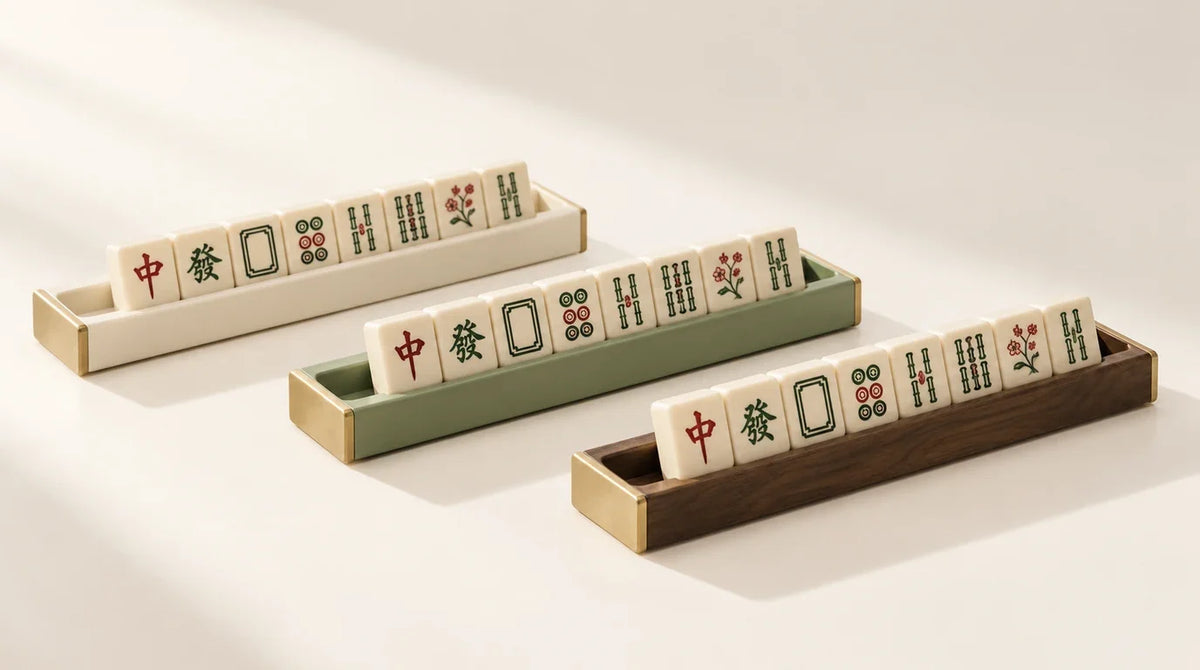
In short. A rack is useful only when it fits the tiles, the table and the way the group moves its walls. Start with the channel width against your thickest tile, then check the usable length, since a listed size usually includes end caps and pusher attachments and 18.5 inches is a common length. The front lip must leave corner numbers and wind letters visible from the seat, and the base should not rock on your actual mat. Replacing one piece means matching dimensions before color.
A mahjong rack is useful only when it fits the tiles, the table and the way the group moves its walls. Published length is important, but channel width, lip height and base stability can change the experience just as much. Pusher designs also require different motions and storage. Check these seven details with the actual tile set whenever possible.
Along the way, we share what players describe in American mahjong groups on Facebook: the questions they asked before buying racks and the details they noticed once the racks reached the table.
- A channel that fits the tile thickness
- Enough usable length for the hand
- A lip that leaves markings visible
- A pusher mechanism the group can use
- A base that stays stable
- A material with realistic care needs
- Four pieces with consistent dimensions
1. A channel that fits the tile thickness
Place several tiles in the channel and look for leaning, pinching or excessive movement. The groove should support the tile without gripping it so tightly that rearranging becomes noisy. Measure thickness at the widest point, including any beveled edge, because a nominal size may not describe how the tile sits.
Test both ordinary tiles and any pieces with a slightly different finish. If the set has natural variation, use the thickest sample. Compatibility is more reliable than a general label such as American size, especially when racks and tiles come from different makers.

Acrylic Mahjong Racks - Larkspur
From $114.99
Four 18.5-inch acrylic racks with attached pusher arms.
2. Enough usable length for the hand
The listed rack length may include end caps or a pusher attachment, so ask how much channel is actually available. Build a normal full hand and leave a little room for sorting. Tiles should not overlap, balance on the ends or force the player to hide groups behind one another.
Longer is not always better on a compact table. Four oversized racks can crowd the corners and leave little room for cards. Measure the tabletop with all four seats in place, then compare the usable channel rather than choosing by one dimension alone.
From the table: rack length is a common question in the groups. Lindsay, who had just bought her racks in 20 inches, asked the group, "What size rack do you all usually buy?" and wondered whether hers were too big. A walkthrough of rack options in another group opens on exactly that point: know the sizes first, starting with the 18.5-inch rack.
3. A lip that leaves markings visible
The front lip holds tiles in place, but it should not cover corner numbers, wind letters or decorative information needed during play. Sit at the normal chair height and read the lower part of every face. A rack that looks clear from above may hide details from the player's actual angle.
Visibility depends on tile height, rack angle and table height together. Test the combination under normal lighting and with the annual card nearby. If a player repeatedly lifts tiles to identify them, the setup is not doing its job.

Clear Mahjong Racks - Snowdrop
From $103.99
Clear racks with a low profile and hinged pushers.
From the table: one member of Mah Jongg, That's It! rotates several tile sets through the week on the same black mat. Her two small gooseneck lamps handle late afternoons and darker tiles: "The two little gooseneck lamps will light the whole table when needed (late afternoon or darker tiles)." Good light makes every corner number easier to read, whatever the rack.
4. A pusher mechanism the group can use
Attached, hinged, magnetic and separate pushers each have advantages. A fixed arm is always present, a hinge folds, a magnet detaches and a separate pusher can be positioned freely. The best design is the one every regular player can operate without pinching fingers or losing a component.
Build a full wall and move it several times. Watch for a hinge that drops, a magnet that releases unexpectedly or an edge that catches the mat. The mechanism should remain predictable at a slow teaching pace and during a familiar fast setup.

Magnetic Mahjong Racks - Aspen
$82.99
A set of four racks with removable magnetic pushers.
From the table: pusher preferences run deep. Matthew, in Mah Jongg, That's It!, builds his own racks and asked the group, "What’s yalls preferred method for the pusher to attach, two magnets, one magnet and a hinge, no magnets and just a pivot point, something else?" Other players say they will always pick a scalloped edge, and one counted the removable pushers among the things she liked most about her new set.
5. A base that stays stable
Press lightly at both ends of the loaded rack. It should not rock, twist or slide when tiles are rearranged. Test on the actual surface because a polished base behaves differently on wood, felt and a velvet-touch mat. Non-slip details can help, but they must not snag fabric.
Inspect all four bases for warping and debris. A tiny protective film or packing fragment can create wobble. Stability also depends on placing the rack fully outside the wall rather than balancing it on a mat edge.
6. A material with realistic care needs
Acrylic, wood and other materials respond differently to cleaners, heat, sunlight and impact. Choose a finish the host can maintain without special effort. Clear acrylic may show fingerprints, acrylic can scratch and wood can react to moisture. Follow the maker's care guidance instead of using a strong household cleaner by default.
Storage matters as much as wiping. Keep dense tiles from striking rack edges in a shared bag and protect detachable pushers from bending. A rack that travels every week needs a sleeve or compartment, while a set that remains at home can prioritize display and easy access.
From the table: one player unpacking new tortoise-finish racks was most taken with how they were stored. Selena, in Mah Jongg, That's It!, explains: "The bag they come with is a thick, soft material with fabric dividers so the racks don’t rub against each other." They also include a cloth for wiping the racks down, and the same idea works at home with any soft sleeve that keeps the pieces apart.
7. Four pieces with consistent dimensions
A table needs four reliable player positions. Buying a set of four reduces variation in length and pusher style, but every piece should still be checked. Load each channel, operate each mechanism and compare the bases side by side. One defective piece can create the same disruption as a mismatched collection.
If replacing a single rack, match dimensions before color. A near match may hold fewer tiles or place one player's hand at a different angle. Record the measurements and product name so a future replacement decision begins with accurate information.

Mahjong Racks with Pushers - Larch
From $96.99
Four coordinated 18.5-inch racks with built-in pushers.
From the table: one player's husband built her a set of wooden racks and stained them purple to go with her lilac tiles: "He made these wooden mahjong racks and stained them purple to go with my lilac soirée tiles. He said it was a labor of love." She adds that purple is hard to photograph, that the racks look even better in person, and that a set made as one is the simplest way to keep every seat alike.
Bring one representative tile when shopping in person, or record exact dimensions for an online purchase. Ask for channel and usable-length measurements when they are not listed. Product photos can show color and shape, but they rarely prove how a full hand will sit. A short measurement check prevents most fit problems before the box is opened.
Evaluate the table as a group of four positions. Put the racks on the intended mat, add cards and build every wall. Confirm that corners do not collide and that each pusher clears the neighboring setup. A rack can work perfectly in isolation and still be too large for the host's table once all four seats are occupied.
After choosing, keep care instructions and purchase details with the case. Record the product name, material, measurements and pusher type. If a piece is lost or damaged, those facts make a precise replacement possible. Routine storage should separate racks from heavy tiles, support long acrylic parts and keep detachable components together.
Invite one regular player to test the shortlisted rack before buying for the entire group. Differences in vision, reach and hand mobility can reveal an issue the host did not notice. A mechanism that feels elegant to one person may be awkward for another, so the best set of four is the one every seat can operate comfortably and consistently.
When the set arrives, keep the packaging until all four pieces pass a full table test. Check for protective films, sharp edges, wobble and uneven attachments. Photograph any defect before use and follow the seller's return process rather than attempting a repair that could weaken acrylic or void support.
| Rack feature | What to test | Warning sign |
|---|---|---|
| Channel | Tile thickness and movement | Leaning or pinching |
| Usable length | A full organized hand | Crowding at the ends |
| Front lip | Lower markings from the seat | Numbers hidden |
| Pusher | A complete wall movement | Catching or releasing |
| Base | Loaded rack on the real surface | Rocking or sliding |
| Material | Cleaning and transport | Fragile finish |
| Set of four | Every player position | Uneven dimensions |
Keep reading: The accessories that do the work at a mahjong table
Common questions
How long should an American mahjong rack be?
How do I know whether tiles fit a rack?
Which pusher design is best?
Should I buy one rack or a set of four?