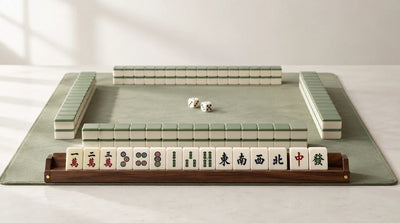
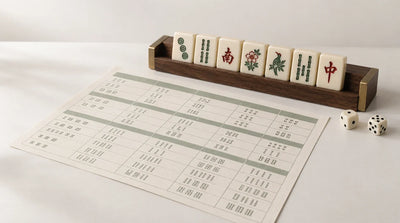
5 Reasons American Mahjong Players Use Racks and Pushers
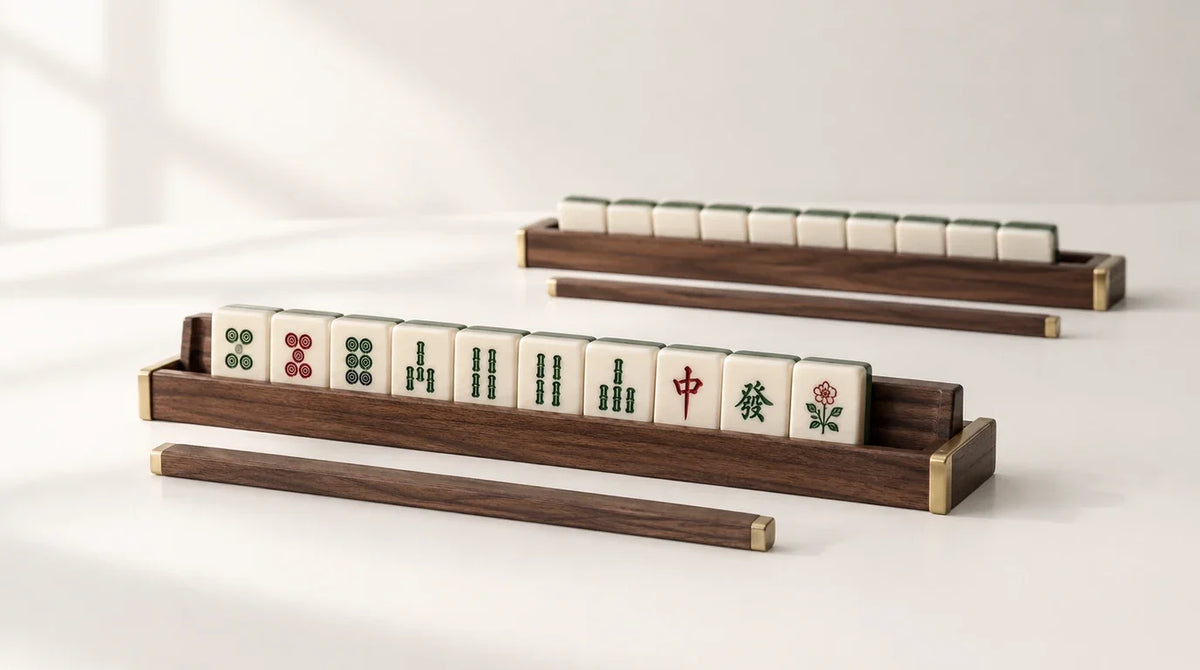
In short. Racks and pushers solve two different physical problems. The rack holds a full concealed hand, keeping tiles upright and angled so only the seated player can read them, while the pusher moves a completed wall without anyone reaching across the center. One layout players describe puts flowers and jokers on the left, suits in the middle in number order and winds and dragons on the right. Four compatible racks make seat rotation fair; fit and stability matter far more than matching colors.
Racks and pushers solve different physical problems at an American mahjong table. The rack holds and organizes a player's hand, while the pusher moves a completed wall without reaching through the center. Designs vary, but fit and stability matter more than decoration. These five reasons show why players test racks with their actual tiles instead of treating them as interchangeable accessories.
Along the way, we look at the questions that come up around racks and pushers and the habits that keep a game running smoothly.
- Racks organize a full concealed hand
- The rack protects the player’s private information
- Pushers move the wall without a long reach
- Consistent equipment makes seat rotation easier
- The right rack improves visibility and pace
1. Racks organize a full concealed hand
A rack gives every tile a stable place while a player sorts suits, pairs and possible card hands. The channel should be long enough for a full hand without stacking pieces or forcing them together. A stable base also lets a player rearrange quietly without sending tiles forward onto the table.
Load the rack before buying. Check the channel width, angle and front lip with the actual tile dimensions. Faces should remain visible to the seated player while concealed information stays out of neighboring sight lines. A label such as standard does not guarantee compatibility across makers.

Acrylic Mahjong Racks - Larkspur
From $114.99
Four 18.5-inch acrylic racks with attached pushers.
From the table: a rack layout that works well puts flowers and jokers at the left end, the three suits in the middle in number order, and winds and dragons at the right. There is no single right way to arrange a rack. The best order is the one that helps you recognize your patterns quickly.
2. The rack protects the player’s private information
Concealed tiles should face the player rather than lie flat where others can glimpse them during sorting. A well-angled rack makes the hand readable from the seat and less visible from the sides. This is especially helpful for beginners who spend more time scanning the annual card and reorganizing groups.
Privacy should not require hunching over the table. If tiles lean too far back or sit below a tall lip, the player may lift them repeatedly and accidentally expose the hand. Test posture at each chair, since table height and rack angle work together.
3. Pushers move the wall without a long reach
Once a wall is built, a pusher helps slide it toward the center while keeping the line together. This reduces the need to lean across another player's space and makes the opening setup more accessible for people with limited reach. The movement should be smooth rather than forceful.
Hinged, magnetic, built-in and separate pushers each require a slightly different motion. Practice with a full wall on the intended surface. A hinge should not collapse, a magnet should hold predictably and a separate arm should not catch on the mat edge.

Clear Mahjong Racks - Snowdrop
From $103.99
Clear 18.5-inch racks with hinged pushers for moving each side of the wall.
From the table: the push that clears the broken wall is worth a little practice. As you compare rack styles, the question is whether you want a rack with an attached pusher or one with a detachable pusher. An efficient push is one of the little things that makes the biggest difference.
4. Consistent equipment makes seat rotation easier
Four compatible racks give every player the same amount of space and a familiar pusher action. When seats rotate, no one inherits a shorter channel or a loose mechanism. A coordinated set also makes it easier to identify which piece is missing during cleanup.
Matching colors are pleasant but secondary. Compare bases for wobble, inspect every attachment and load all four channels. Manufacturing variation or wear can affect one piece even when the set arrived together. Replace a problem based on function, not merely because the finish has aged.

Mahjong Racks with Pushers - Larch
From $96.99
A coordinated set of four racks with built-in pushers.
From the table: the tiles, the racks and pushers, and the mat do not have to come from the same maker for the table to look lovely. What the four seats need to share is fit and function. The finishes can mix.
5. The right rack improves visibility and pace
When tiles stand at a readable angle, players can compare the rack with the card without picking up pieces one by one. That shortens routine scanning and keeps turns moving. Clear organization also makes it easier to notice how many tiles are in the hand before a discard.
Choose contrast between tiles, rack and mat. Clear acrylic can disappear visually on some surfaces, while a strong color may compete with detailed tile backs. Test the whole table under evening light. The goal is not speed for its own sake, but a setup that removes avoidable physical pauses.

Magnetic Mahjong Racks - Aspen
$82.99
Four colored racks with wavy magnetic pushers.
From the table: racks with real cane encased in the acrylic are worth a look, especially for the slope. That slope is what lets a hand read clearly from the seat without lifting a tile.
Racks and pushers should be selected as a system with the tiles and surface. Measure the tile, load a hand, move a wall and repeat the test at all four seats. Those steps reveal more than a product photograph or a single length measurement.
Clean and store the pieces according to their material. Keep heavy tiles from striking acrylic edges during transport and do not force a stiff hinge. Careful handling preserves alignment, which is the feature players depend on every time they build the table.
For a new group, demonstrate the two tools separately. First show how the rack keeps a concealed hand upright and organized. Then build one wall and show how the pusher brings it into position. This prevents a beginner from using the pusher as extra storage or lifting the rack when only the wall needs to move. Repeat the motion slowly at each seat so left-handed and right-handed players can find a comfortable grip.
Table geometry matters. A high table with low chairs can make a rack face difficult to read, while a very wide table increases the value of a long pusher. Set four chairs before judging the equipment. If a player still leans forward, adjust the chair, rack angle or table position before buying a different accessory. Comfort comes from the relationship between the pieces, not from the rack alone.
During cleanup, count four racks and four pusher components before packing the tiles. Magnetic and separate arms are easy to leave beneath a mat or beside a chair. Give them a fitted sleeve or a consistent compartment, and keep paper cards away from hard acrylic edges. A repeatable packing order makes the next setup faster and protects the mechanism that the group depends on.
When one rack fails, compare the cost and accuracy of a single replacement with a new set of four. A replacement must match channel width, usable length, base height and pusher action. If it cannot, using four new consistent pieces may be less distracting than asking one seat to adapt. Keep the sound racks as spares only when their dimensions remain useful.
Racks and pushers are not required by every form of mahjong, which is why a traditional Chinese set may arrive without them. For an American group they support the expected physical rhythm around the card. Identify the ruleset before shopping, and do not crowd a compact table with long racks simply because they appear in another group's photographs.
Before replacing equipment, ask the group which problem it is solving: crowded hands, poor privacy, a difficult reach or inconsistent seats. That answer determines whether the rack, pusher or table layout needs attention. A focused change is easier to test than replacing every visible part at once, and it preserves equipment that already works well. Write the answer down before comparing products, then repeat the wall test after the change.
| Reason | Rack or pusher role | Main test |
|---|---|---|
| Organize the hand | Rack | Full hand fits without crowding |
| Protect information | Rack | Readable only from the seat |
| Move the wall | Pusher | Smooth motion without reaching |
| Standardize seats | Both | Four pieces work consistently |
| Improve visibility | Rack | Faces stay clear above the lip |
Keep reading: Our guide to everyday mahjong accessories · Avoiding common beginner setup mistakes
Common questions
Why do American mahjong players use racks?
What is a mahjong pusher used for?
Do all mahjong racks fit all tiles?
Are magnetic pushers better than hinged pushers?