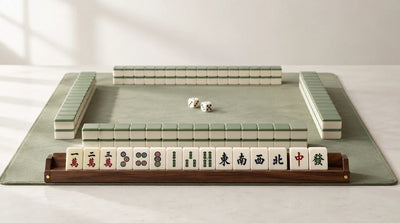
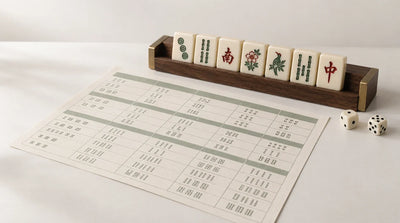
5 Things the NMJL Card Does Not Include
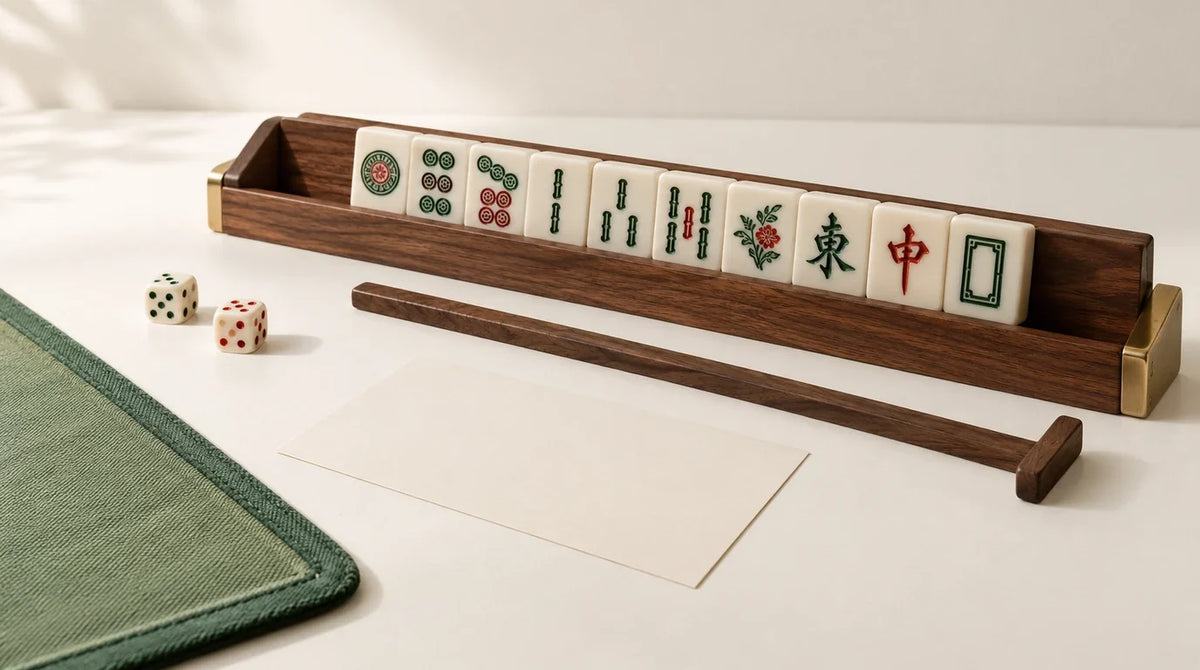
In short. The annual card supplies the hands for one season and nothing else. It does not arrive with tiles, so an American set with jokers is still required, and it brings neither the four racks and pushers that hold a hand and move the walls nor the dice, surface or wind marker. It is not a beginner lesson either: a new player still has to learn the Charleston, exposures, jokers and how a winning hand is declared. Hosting and etiquette stay group decisions.
The annual National Mah Jongg League card is essential for American mahjong, but it is not a complete game kit or a full course. It presents the hands and information authorized for that season, while players supply the physical set and learn how play works. Understanding that boundary prevents a new player from expecting one purchase to answer every practical question. These five items must be obtained, learned or agreed on separately.
Along the way, we look at the questions that come up before a first game, the gear that gathers around the card and the habits that keep a table running smoothly.
- A physical American mahjong tile set
- Four racks and a way to move the walls
- A prepared table and shared accessories
- A complete beginner lesson
- Automatic answers to every table question
1. A physical American mahjong tile set
The card does not arrive with tiles. Players need access to an American mahjong set containing the suits, winds, dragons, flowers and jokers used in card play. Readable corner numbers and lettered winds are helpful for beginners, but the exact appearance is a matter of product design. The official card remains separate even when a retailer describes a set as complete, so check the contents rather than assuming it is tucked into the bag.
A product can be a mahjong set and still be designed for Chinese play. Traditional Chinese sets commonly use a different tile mix and do not contain the jokers required for American card hands. Before buying, confirm the variant, total count, joker count and blank count. If the listing includes racks or accessories, verify their dimensions and quantities separately. The card tells you which hands are available, not whether the equipment in front of you is compatible.
From the table: buying a first set and laying it out can make one thing obvious: there is no League card yet. Ordering the card at the same time as the tiles saves that pause before the first game.

American Mahjong Set with Racks - Zinnia
From $174.99
A complete American setup with 166 tiles, four racks, pushers, chips, dice, a wind indicator and a bag.
2. Four racks and a way to move the walls
The card does not provide racks, and it does not determine which pusher mechanism a group should use. American players normally arrange concealed tiles on a rack and use a pusher or the rack itself to move the wall. Four players therefore need four stable positions. The channel must fit the actual tiles, hold a full hand comfortably and leave the markings visible above its front edge.
Choose between attached, hinged, magnetic and separate pushers according to the group's routine. A mechanism that is easy for every seat matters more than a matching color. Test the rack on a flat table and slide a complete wall before the first game. If a tile set includes racks, do not assume they are the preferred length or style. Those physical decisions sit outside the annual card.
From the table: which racks suit taller tiles is a common question. Lining several racks up side by side to compare the backrest, the sloped part the tiles lean against, and the exposure area clarifies it. Seeing tiles actually sitting in each rack is the quickest way to judge fit.

Clear Mahjong Racks - Snowdrop
From $103.99
Four clear 18.5-inch racks with hinged pushers for an American mahjong table.
3. A prepared table and shared accessories
The card does not create a playing surface, supply dice or organize the center of the table. A host must provide enough space for four racks and a square wall, plus room for every player to read her card. A mat is optional, but it can soften tile noise, improve grip and make pieces easier to lift. Its dimensions, pattern and backing should suit the table rather than being chosen only for color.
Gather any dice, wind indicator and scoring pieces the group uses before guests arrive. Different groups may handle some practical details differently, so the host should explain the table routine without presenting it as text from the annual card. Keep drinks outside the active tile area and make sure lighting reaches all four seats. These small choices determine whether the card can be read comfortably through a full session.
From the table: a mat is a separate decision too. Matching a mat to a boldly themed set takes some searching, and a mat that arrives folded is a common frustration. It helps to picture your own tiles on a mat before you choose.

Green Mahjong Mat - Selva
$89
A green botanical mat with a velvet-touch top, stitched edge and anti-slip backing.
4. A complete beginner lesson
The card is a compact seasonal reference, not a step-by-step beginner course. A new player still needs to learn tile names, seating, the Charleston, drawing and discarding, exposures, jokers and how a winning hand is declared. She also needs practice reading abbreviations and matching the color pattern printed for a hand. Trying to learn all of that only by staring at the card can make the game feel more mysterious than it is.
Use a qualified teacher, a trusted rules resource or a patient group that agrees to play open practice hands. Teach one sequence at a time and explain which information comes from general American mahjong rules and which information must be read directly on the current card. The annual card should become easier to use as instruction progresses, but it should not be copied, rewritten or treated as a substitute for learning the flow of play.
From the table: a first lesson is about building a foundation, not about getting Mahjong. Between lessons, practicing on your own helps: dealing yourself a solo hand from the bag works on reading the card and choosing Charleston passes at your own pace, and a phone app can get you playing more often.
5. Automatic answers to every table question
The card does not settle every matter of hosting, etiquette or group habit. Players still need to agree on arrival time, teaching pace, rotation of seats, use of scoring pieces and how they handle interruptions. A visible wind indicator can support a shared routine, but the accessory does not create that routine. When a question concerns official play, consult the current NMJL materials rather than relying on a memory from another group.
Separate three kinds of information: the hands shown on the current card, the broader rules of American mahjong and the house habits chosen for convenience. This distinction prevents a friendly preference from being taught as an official requirement. It also makes disagreement easier to resolve. Players can check the appropriate source, make a clear table decision and return to the game without asking the card to cover a topic it was never designed to include.
From the table: a question that comes up again and again is whether something is an official rule or simply etiquette. The order for displaying a winning hand is a good example, since many groups just like to know which is which. Each group also decides for itself when to move to the new card, so it is worth asking how the table handles the changeover.

Mahjong Wind Indicator - Cypress
From $45.99
A compact wind cube and holder that gives the table one visible reference.
A useful way to prepare is to place the card at one seat and then inventory everything else needed for a real hand. The card supplies the seasonal reference, while the group supplies the tiles, four player positions, a readable surface and the knowledge to carry out the rules. This distinction keeps shopping practical. It also prevents a beginner from blaming the card when the actual problem is poor lighting, incompatible racks or a tile set made for another form of mahjong.
When a question arises, identify its category before looking for an answer. Read the current card for the current hands, consult official NMJL materials for official American mahjong questions and make local hosting decisions openly as a group. That approach respects the role of the annual card without asking it to be a rulebook, equipment list and etiquette guide at the same time.
Before inviting a beginner, send a short practical list that separates the official card from the shared equipment. Ask her to bring the correct card and tell her what the host will provide. This avoids duplicate purchases, gives the teacher time to check the set and makes the first conversation about learning rather than about missing objects.
| Not included | What to arrange separately | First check |
|---|---|---|
| Tile set | American tiles with jokers | Variant and contents |
| Racks and pushers | Four compatible player positions | Tile fit and mechanism |
| Table setup | Space, lighting and optional mat | Four-seat visibility |
| Beginner instruction | Lessons and guided practice | Reliable teacher or resource |
| House decisions | A clear group routine | Official rule or local preference |
Keep reading: Getting ready before the 2027 card arrives · Card-season essentials for American players
Common questions
Does the NMJL card include mahjong tiles?
Does an American mahjong set include the NMJL card?
Can a beginner learn American mahjong from the card alone?
Does the NMJL card decide house rules?