Mahjong Dragon Tiles
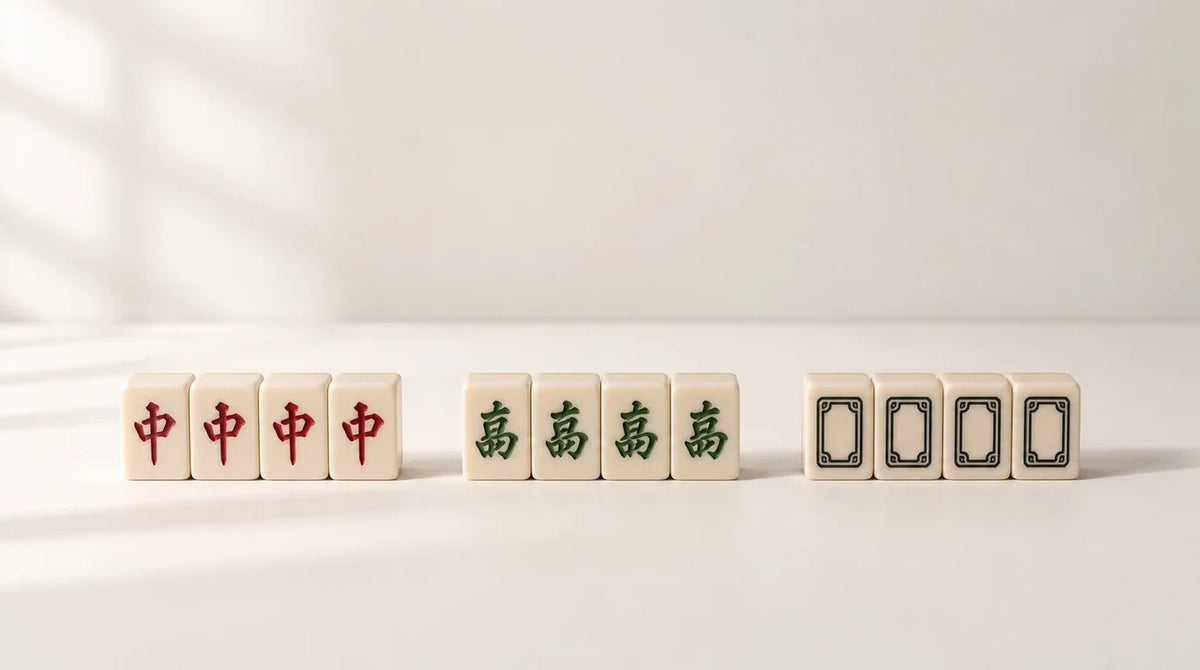
In short. Every standard set holds twelve dragon tiles — four red Chun, four green Hatsu and four white Haku — and they count as honor tiles, never part of a numbered sequence. The red dragon stands for the center, the green for prosperity, and the white is the plain tile players nickname soap. Western sets often add the letters C, F and P to tell them apart. In riichi a dragon triplet is a yaku, while in American play the annual card decides where dragons fit.
Every standard set features twelve mahjong dragon tiles divided into three distinct types: the red Chun, the green Hatsu, and the white Haku. These honor tiles represent the core virtues of benevolence, sincerity, and filial piety while serving as essential scoring components in every regional variation of the game.
New players often struggle to distinguish the white dragon from a blank spare tile, especially since American sets can include up to 166 tiles. We will examine the unique symbols of each dragon, their specific suit pairings, and how they function within the complex scoring systems of Hong Kong, Riichi, and American play.
- The Core Identity of Mahjong Dragon Tiles: A Foundation of Honor
- Decoding the Red and Green Dragons: Symbols of Success and Center
- The White Dragon Mystery: Navigating Frames, Blanks, and Soap
- Global Scoring Dynamics: Regional Rules from Hong Kong to Riichi
- Modern American Sets: Understanding Jokers, Blanks, and Tile Counts
The Core Identity of Mahjong Dragon Tiles: A Foundation of Honor
Mahjong sets feature twelve dragon tiles comprising the Red (Chung), Green (Hatsu), and White (Haku) types. These honor tiles represent success, prosperity, and purity, serving as essential scoring components across all regional variations.
The Place of Dragons in the Honor Category
Dragons are classified as honor tiles alongside the four winds. They hold a distinct status separate from the numbered suits. Their strategic value remains high throughout the match.
These pieces differ significantly from dots, bams, and cracks. They lack any numerical sequence or rank. Their presence in a starting hand often dictates early game strategy.
Players frequently seek these prestigious pieces. They are the most coveted tiles for building high-value, complex hands.
The Universal Count of Four per Type
Standard sets require four tiles for each specific dragon color. This results in a total of twelve dragon tiles per set. The math is simple but vital. Every player must track these twelve specific pieces.
This fixed quantity directly affects the probability of forming triplets. It makes collecting a complete set quite challenging.
Dragons are fewer in total types compared to winds. However, they share the same individual tile frequency.

Historical Naming and Cultural Roots
The dragon name evolved primarily through early Western translations. Translators chose this mythical term for English speakers. It replaced the literal Chinese descriptions found on the characters.
These tiles carry deep symbolic meanings in traditional play:
- Red Dragon represents the Center
- Green Dragon represents Prosperity
- White Dragon represents Purity/Emptiness
These tiles represent abstract concepts. They are not literal depictions of scaly beasts.
Explore our collection of beautifully crafted sets to find the perfect dragons for your next game night.
Decoding the Red and Green Dragons: Symbols of Success and Center
But these vibrant tiles carry deeper meanings than simple colors, rooted in the very core of Chinese philosophy and linguistic puns.
The Red Dragon and the Middle Path
The Hong Zhong character signifies the center. Its visual style uses bold red ink. The design features a clear vertical stroke through a rectangle.
This tile connects directly to the concept of achievement. It symbolizes hitting the target or bullseye. This reflects the specific goal of winning the round.
Red carries significant cultural weight. It signifies luck and joy in many Asian traditions. These honor tiles appear four times in each set.
The Green Dragon and Prosperity
The Fa Tsai character carries the meaning of striking it rich. The green color palette is iconic in traditional sets. Modern sets maintain this specific hue. It is the most recognizable tile for wealth.
Some American sets use stylized dragon figures instead of the character. These icons provide a visual alternative for players who prefer illustrations over calligraphy.
Green also links to the Spring season. It represents growth and the flourishing of new life. This tile is traditionally associated with the Bams suit.

Identifying Tiles with Western Letters C and F
Western sets include the letters C and F for clarity. C stands for Chung, the romanization of 中, representing the Red Dragon. F stands for Fa, the romanization of 發, representing the Green Dragon.
These letters come from the romanized Chinese names of the tiles. They help beginners identify tiles without reading Chinese characters. This social addition makes the game more accessible.
These markings bridge the gap for new enthusiasts. They allow international players to enjoy the game immediately. It ensures the table remains inviting for everyone.
Explore our curated selection of high quality sets to find the perfect dragons for your next game night.
The White Dragon Mystery: Navigating Frames, Blanks, and Soap
While the Red and Green tiles are easy to spot, the White Dragon often causes confusion due to its minimalist and evolving design.
Haku and the Evolution of the Blank Tile
The traditional White Dragon is famous for its simple, undecorated surface. It is known as Haku in Japanese play. The surface is completely smooth and white.
Many players use the nickname soap for this piece. The smooth surface feels like a bar of soap. This tactile quality is a favorite for veteran players.
Purity holds deep cultural significance. Emptiness represents the ultimate state of potential in the game.

Telling the Difference Between Dragons and Spares
Identifying a playable dragon from a spare requires a keen eye. Spare tiles are truly empty and flat. Dragons often have a subtle finish or frame.
Playing with extra tiles creates a serious risk. Accidentally adding spares ruins the deck balance. Always count your set before starting a match.
| Feature | White Dragon | Spare Tile |
|---|---|---|
| Surface Design | Framed or Blank | Truly Empty |
| Purpose | Scoring | Replacement |
| Quantity in Set | 4 per set | Varies |
| Tactile Feel | Smooth or Etched | Flat |
The Blue Border and the Letter P
Many modern sets use a blue or black border. This rectangular frame design is very common.
Some English sets include the letter P. It stands for Pai, the Wade-Giles romanization of 白 (white). This helps prevent confusion with blank spares.
This border significantly aids visibility. It makes the tile stand out against the table.
Discover our curated selection of authentic mahjong sets to find the perfect dragons for your next game night.
Global Scoring Dynamics: Regional Rules from Hong Kong to Riichi
Understanding the visual identity is only half the battle; the real power of dragons lies in their diverse scoring potential across borders.
Traditional Chinese and Hong Kong Point Systems
Dragon tiles function as honor tiles, contributing significantly to "Fan" scoring units. A set of three identical dragons provides an immediate boost. It is an easy way to score.
Collecting all three types, known as Great Three Dragons, is rare. This combination often results in a maximum score. It remains a sought achievement for players.
The Small Three Dragons variant offers another path. This involves two sets and a pair of the third type. It provides five fans.
Riichi Mahjong and the Yaku Multipliers
In Japanese play, dragons serve as Yaku scoring requirements. A triplet of dragons provides an automatic point. This allows the player to win. It is a common strategy in Japan.
Dragons interact with the Dora indicator during the game. They can become bonus tiles. This increases their value significantly. Players watch these indicators closely.
Keeping dragons carries heavy strategic weight. They are useful for both offense and defense. Discarding them requires very careful timing.
Strategic Suit Associations for Each Dragon
Players pair the Red dragon with the Cracks suit. This creates a visual symmetry. Many players group them together mentally. It simplifies building complex hands.
Pair the Green dragon with Bams during your sessions. In specific variations, this pairing unlocks special bonuses. It aligns with the natural tile colors.
Pair the White dragon with Dots to maintain order. This completes the traditional thematic set. It ensures a balanced approach to the suits.
Discover our collection of premium American mahjong sets, featuring 160 or 166 tiles to suit your preferred style of play.
Modern American Sets: Understanding Jokers, Blanks, and Tile Counts
The American version introduces unique elements that change the tile count and the role of dragons. It is a structured departure from traditional styles.
Understanding Tile Counts of 160 or 166
American sets vary in count, differing from the standard 144 tiles. These sets include eight jokers and extra spares for gameplay. This variety reflects the social nature of the US game.
Many sets include multiple blank tiles. These function as replacements for lost pieces or as special jokers. The total count can reach 166 tiles in modern configurations.
The number 152 is not the only standard. Modern sets offer various configurations for players. You will find plenty of variety in today's market.
How Dragons Function on the Annual Card
The National Mah Jongg League (NMJL) card is the ultimate authority. It dictates how dragons are used each year. These rules change every April to keep the game sharp.
Players must purchase the card directly from the NMJL. It lists specific groupings like consecutive runs. Dragons often act as zero or represent specific suits during play.
The current year brings interesting strategic shifts for dragon enthusiasts.
- Dragons used in '2026' year hands
- Dragons used in 'Consecutive Run' sections
- Dragons used in 'Quints'
Maintaining Quality Engravings and Materials
I recommend identifying deep engravings. Surface paint wears off quickly during frequent gatherings. Look for tiles with physical depth in the design for longevity.
Cleaning tiles requires a gentle touch. Use mild soap and a soft cloth. Avoid harsh chemicals that might damage the delicate ink in the engravings.
Proper storage is the best way to protect your investment. Use lined cases to prevent chipping. Good care preserves the vibrant red and green colors.
Feel free to explore our inviting selection of premium tiles to find a set that truly resonates with your style.
Mastering the Red, Green, and White honor tiles is essential for strategic success across all regional styles. By identifying these twelve specific pieces and their suit pairings, you ensure accurate scoring and avoid common confusion with blank spares. Elevate your next match by exploring our premium mahjong dragon tiles to find the perfect set for your table.
Common questions
What do the three dragon tiles look like in a standard set?
The three dragon tiles are distinct honor tiles known as the Red, Green, and White dragons. The Red Dragon, or Chun, typically features the red Chinese character "中," symbolizing the center, though some Western sets include a small letter C. The Green Dragon, known as Hatsu, usually displays the green character "發" for prosperity, or a stylized dragon icon in American sets, sometimes accompanied by the letter F.
The White Dragon, or Haku, is unique for its minimalist design, often appearing as a completely blank white tile or a tile with a simple blue or black rectangular frame. In certain Anglophone sets, it may be marked with the letter P to stand for "Pai", the Wade-Giles romanization of 白. Because of its smooth surface, many players affectionately refer to this tile as soap.
How many dragon tiles are included in a mahjong set?
Every standard mahjong set contains a total of twelve dragon tiles. This count is divided equally among the three types, meaning there are exactly four Red Dragons, four Green Dragons, and four White Dragons. This fixed quantity is essential for maintaining the mathematical balance of the game, as players must track these specific pieces to form triplets or higher scoring combinations.
While the total number of tiles in a set can vary, especially in American mahjong which may include 160 or 166 tiles due to jokers and blanks, the core number of dragons remains constant at four of each kind. This consistency allows the dragons to function as reliable honor tiles across all regional versions of the game.
How do the dragons pair with the different suits?
In many variations, particularly American mahjong, the three dragons are strategically associated with the three suits to create a thematic balance. The Red Dragon is paired with the Cracks (Characters) suit, while the Green Dragon is linked to the Bams (Bamboos) suit. The White Dragon completes the trio by associating with the Dots (Circles) suit.
These pairings often influence how hands are structured on the National Mah Jongg League card or in specific regional scoring rules. Mentally grouping these honor tiles with their respective suits helps players organize their hands and recognize potential scoring patterns more efficiently during a match.
What is the role of dragon tiles in scoring across different regions?
Dragon tiles serve as powerful scoring tools, though their specific roles change depending on the ruleset. In Chinese and Hong Kong mahjong, they are honor tiles where a set of three contributes to "Fan" units. Rare hands like the "Great Three Dragons," which uses all three types, can result in maximum scores. In Riichi mahjong, a triplet of dragons provides an automatic "Yaku," a necessary requirement to win a hand, and they can even serve as "Dora" for bonus points.
In American mahjong, the role of dragons is dictated by the annual card issued by the National Mah Jongg League. These tiles are required for specific combinations, such as consecutive runs or year hands, where the White Dragon often represents the number zero. Note that the NMJL card is not sold by equipment shops; it must be purchased directly from the League.
Why is the White Dragon often confused with a blank spare tile?
Confusion arises because the traditional design of the White Dragon is a completely blank, smooth surface. Many mahjong sets also include extra blank tiles intended as spares to replace lost or damaged pieces. New players may struggle to distinguish a playable Haku tile from these non-playable replacements, especially if the set does not use a border or the letter P to identify the dragon.
To tell them apart, look for a subtle rectangular frame or a specific finish that matches the other tiles in the set. Spare tiles are typically truly empty and flat, whereas the White Dragon is an active part of the 136 core playing tiles. It is always wise to count your set before playing to ensure the twelve dragons are present and the spares are set aside.
Explore our diverse range of beautifully engraved sets to find the perfect dragon tiles for your next game night.