Mahjong Character Tiles
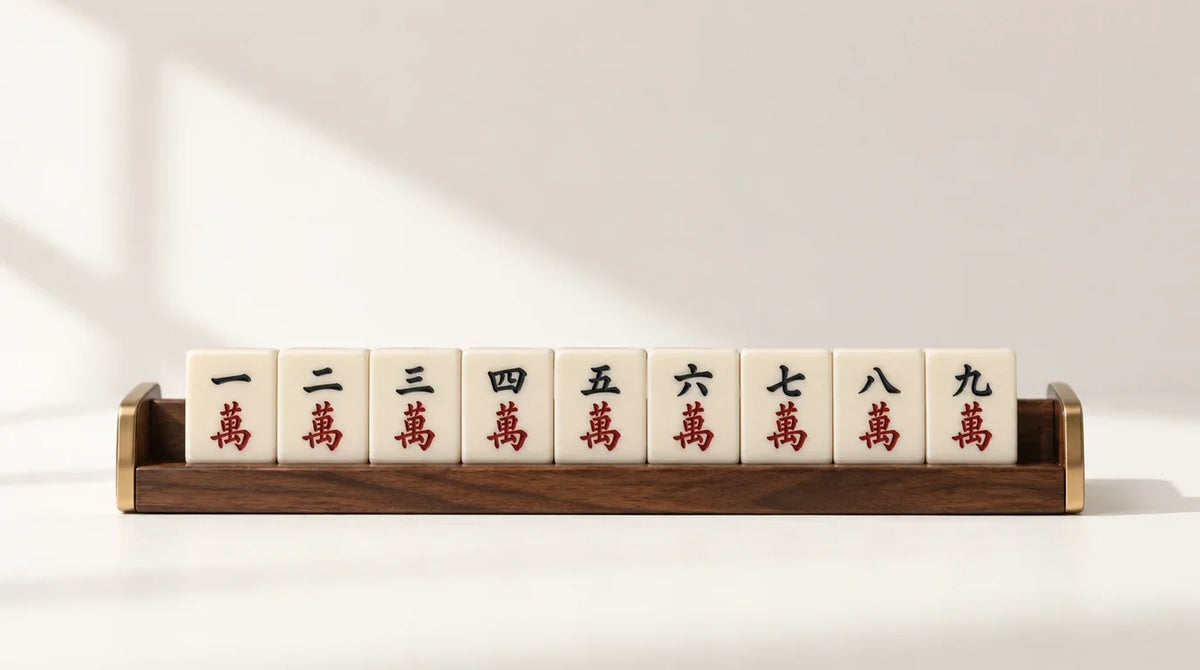
In short. The character suit, called Wan or Craks, is one of the three main suits in American sets and the one that trips up new players. Each tile carries a Chinese numeral one through nine above the character for ten thousand, so the value must be read rather than counted, unlike the circles on dots or the sticks on bams. Four of each number makes 36 character tiles. Mnemonics help: four looks like a window, six like a person in a hat, seven like a hook.
American mahjong sets are sold with 160 or 166 tiles to accommodate various jokers and blanks, yet the character suit remains the most frequent source of confusion for new players. While dots and bams rely on intuitive counting, these tiles demand the recognition of Chinese numerals and the complex symbol for ten thousand.
Newcomers often struggle to identify these calligraphic designs during the fast paced Charleston. This guide provides simple visual mnemonics to help you read mahjong character tiles at a glance, ensuring you never miss a crucial crack during your next game.
- The Foundation of Mahjong Character Tiles: A Suit of Ten Thousand
- How to Read Chinese Numerals at a Glance?
- Distinguishing Character Tiles from Bams and Dots
- The Symbolic Meanings of Wind and Dragon Characters
- American Set Composition and the National Mah Jongg League Card
The Foundation of Mahjong Character Tiles: A Suit of Ten Thousand
American Mah Jongg sets feature the Wan suit, often called Craks, representing Chinese numerals one through nine. These tiles signify myriads or ten thousand, forming the backbone of numerical gameplay alongside Dots and Bams.
The suit relies on specific terminology like "Wan" which defines how players identify these tiles during a fast-paced Charleston.

Identification of the Character Suit and Numerical Range
The Character suit is known as Wan or Craks. It serves as one of the three main suits in American Mah Jongg, mirroring the structure of international versions with distinct cultural markings.
Numbered tiles range from one to nine. Each tile displays a Chinese numeral at the top, while the character for ten thousand sits below it. Red ink typically highlights the lower symbol.
Symbols follow a strict vertical orientation. The top character changes to indicate the value, but the bottom character remains constant. This consistency helps players scan their racks quickly for matches.
Historical Context and the Monetary Origin of Wan
This suit has deep monetary roots. It originally represented strings of copper coins used in ancient Chinese trade, linking the game to commerce.
The name refers to myriads or ten thousand. This specific number symbolizes vast wealth and abundance. It reflects the game's origins in gambling and prosperity rituals used centuries ago.
Over time, literal coin drawings shifted to the abstract script used today. Modern tiles favor calligraphy over old depictions. This evolution simplified mass production of tile sets for global markets.
This history adds depth to every hand played. Understanding the money connection makes the suit feel more tangible during a competitive session.
Why Beginners Find Character Tiles the Hardest
Beginners often struggle because they cannot count individual items on the face. Unlike Dots or Bams, there are no circles or sticks to tally up for the numerical value.
Foreign calligraphy presents a psychological barrier. Non-Chinese speakers often see these as abstract art rather than numbers. This creates a lag in recognition during competitive play or the Charleston.
The suit requires heavy reliance on pure memory. Without patterns, the brain must map a specific shape to a digit. This takes practice to master.
National Mah Jongg League rules demand fast play. Misidentifying a Crak is a common rookie mistake under pressure. Most players eventually overcome this through repetitive exposure to the tiles.
Exploring the intricate designs of a character suit brings a sense of history to your next social gathering.
How to Read Chinese Numerals at a Glance?
Moving from the history of the suit to the actual symbols requires a breakdown of the calligraphy used on each tile face.
Breaking Down the One Through Nine Symbols
Reading mahjong character tiles involves identifying Chinese numerals one through nine. Beginners use mnemonics like stroke counting for recognition. This simplifies the learning curve for new players significantly.
Horizontal strokes represent one, two, and three. These are the easiest to spot. They look exactly like the number of lines they represent, stacked neatly on the tile.
Complex shapes define four through nine. Four looks like a window with curtains. Five resembles a stylized "h" or a person sitting. Six has a top hat appearance. These distinct features help differentiate the higher numbers.

Visual Mnemonics for Non-Chinese Speakers
Suggest associations for the trickier characters. A square shape defines the number four. Seven often looks like a T-shape or a hook. These mental shortcuts prevent hesitation during a turn.
- Mnemonic for 4: a window
- Mnemonic for 6: a person with a hat
- Mnemonic for 7: a hook
- Mnemonic for 8: an open gate
Provide tips for differentiating similar looking characters. Six and nine are often confused by tired eyes. Look for the base of the character to tell them apart. Focus on the unique strokes.
Practice makes these associations automatic. Soon you will see the number, not just the lines. It becomes a reflex.
Discover our diverse selection of American mahjong sets featuring 160 or 166 tiles to enhance your next social gathering.
Distinguishing Character Tiles from Bams and Dots
While the characters demand memorization, comparing them to the geometric suits highlights their unique linguistic nature within the set.
Linguistic Nature vs Geometric Patterns
Wan tiles feature Chinese script, unlike the circles on Dots. Dots are visual and quantitative. You can count them to know the value instantly.
Bams use green and red sticks for numbers. The One of Bamboo is unique, usually featuring a bird. These sticks follow a structured, recognizable pattern.
| Suit Name | Primary Visual | Recognition Method | Difficulty |
|---|---|---|---|
| Dots | Circles | Counting | Easy |
| Bams | Sticks | Counting | Medium |
| Craks | Chinese Script | Memory | Hard |
Characters require a different mental approach since they rely on numerals rather than counting. This suit connects you to the game's traditional roots.

Traditional vs Simplified Chinese Characters on Tiles
Modern sets include traditional or simplified scripts. Some use the complex Wan character. Others use a simpler version. Both are valid.
Traditional characters look dense and ornate. Simplified versions appear cleaner and are easier to read quickly. The ten thousand symbol changes between styles.
Group character tiles numerically to spot gaps. This helps when planning for NMJL hands. Consistency in your specific set is what matters most.
Get used to your tiles' specific font style. It builds confidence as you identify each numeral at a glance during social play.
Discover our curated selection of high quality tiles to find a set that speaks to your personal style.
The Symbolic Meanings of Wind and Dragon Characters
Beyond the numbered suits, the honor tiles introduce a different set of characters representing the winds and the mythical dragons.
Four Winds and Their Cardinal Connections
The honor tiles include specific characters for East, South, West, and North. These tiles sit outside the numbered suits. Each one features a distinct calligraphic style that players must identify.
Directions carry seasonal and elemental weight in Chinese philosophy. East represents Spring, while West signifies Autumn. These deep associations frequently dictate the specific hand requirements found in American gameplay.
- East Wind: Spring/Wood
- South Wind: Summer/Fire
- West Wind: Autumn/Metal
- North Wind: Winter/Water
Winds function strictly as honor tiles. They possess no numerical values for creating sequences. Instead, players utilize them to form powerful triplets or quads during a round.
The Three Dragons: Red, Green, and White Soap
Red and Green dragon characters hold deep symbolic meaning. The Red dragon signifies the center or achievement. The Green dragon represents wealth and onset. They are visually bold tiles.
The White dragon, often called soap, is unique. In American sets, it typically features a blue frame. This design helps players distinguish it from spare tiles or simple blanks.
Honor tiles play a vital strategic role. They are necessary for building high scoring hands. Experienced players often hoard these tiles to block their opponents from finishing a hand.
Recognizing these specific characters is just as vital as identifying the numbers. They complete the linguistic puzzle of the set. Explore our curated collections to find a set that speaks to your style.
American Set Composition and the National Mah Jongg League Card
Understanding the tiles is only half the battle; you must also ensure your set contains the correct count for American play.
Understanding 152, 160, and 166 Tile Counts
American sets typically feature 152 tiles. This count includes suits, honors, flowers, and the eight jokers required for league play. It is the standard for most games.
Sets vary in size because some include extra jokers or blanks, reaching 160 or 166 pieces. Always verify the count before starting to avoid confusion during the game.
Tile size also impacts legibility. Larger tiles are easier to read but take up more rack space. Choose a set that balances portability with clear, crisp engraving for social play.
Managing Jokers, Flowers, and the NMJL Card
The National Mah Jongg League card is sold directly by the NMJL. Retailers do not bundle it with sets. You must purchase a new card every year in April.
Flowers and jokers serve specific roles. Flowers act as bonus tiles or hand requirements. Jokers are wild and can substitute for any tile in a pung, kong, or quint.
A well-made set with clear character tiles makes the game more enjoyable. Check out our collection to find the perfect match for your personal style.
Mastering mahjong character tiles requires memorizing Chinese numerals one through nine and the "ten thousand" symbol. By using visual mnemonics like the window for four or the hook for seven, you will quickly identify Craks during fast-paced play. Practice these associations today to transform your next Charleston into a confident victory.
Common questions
What are the character tiles in a Mahjong set?
The character suit, often called Wan or Craks, is one of the three main suits in American Mahjong. These tiles represent Chinese numerals from one through nine, with the character for ten thousand (Wan) appearing at the bottom of each tile to signify abundance and wealth. In a standard game, there are four of each numbered tile, making 36 character tiles in total.
While the top character changes to indicate the specific number, the bottom symbol remains consistent across the suit. This vertical layout helps players identify the suit at a glance, even if they are not yet familiar with the calligraphy. These tiles provide a direct connection to the historical roots of the game, where they originally represented strings of currency.
Why do new players find the character suit particularly challenging?
Beginners often struggle with character tiles because they lack the intuitive counting method found in Dots or Bams. Unlike the Dots suit, where you can simply count the circles to find the value, character tiles rely entirely on recognizing Chinese calligraphy. This creates a psychological barrier for those unfamiliar with the script, as the symbols can initially look like abstract art rather than numbers.
The pressure of fast paced play, especially during the Charleston, makes quick recognition difficult for rookies. Without a visual tally of sticks or circles, the brain must map a specific shape to a digit through pure memory. Most players overcome this hurdle through repetitive exposure and by using simple visual mnemonics to differentiate the more complex characters.
How can I easily memorize the Chinese numerals on the tiles?
Memorizing the numerals is simpler when you focus on the number of horizontal strokes for the first three numbers: one (一), two (二), and three (三). For the higher numbers, visual associations are very effective. For instance, four (四) looks like a window with curtains, while six (六) resembles a person wearing a small hat. Seven (七) can be identified by its hook shape, and eight (八) looks like an open gate or a pair of legs.
Practice by looking at your tiles and saying the number and suit name aloud to build muscle memory. Many players find that focusing on the unique top stroke of each character allows them to identify the tile without needing to scan the entire face. Over time, these associations become a reflex, allowing for seamless integration into your strategy.
What is the difference between character tiles and the Dots or Bams suits?
The primary difference lies in how the numerical value is communicated to the player. Dots (or Circles) are purely quantitative, featuring a number of circles that corresponds exactly to the tile's value. Bamboo tiles (or Bams) use linear stalks to represent numbers, though the One of Bamboo is a famous exception that usually features a bird, such as a sparrow.
Character tiles are linguistic in nature rather than geometric. They require the player to read a numeral rather than count a pattern. This distinction makes the character suit feel more formal and calligraphic compared to the more playful, visual designs of the other two suits. Each suit offers a different sensory experience, contributing to the rich tapestry of a Mahjong hand.
What do the Wind and Dragon characters represent in the game?
Wind and Dragon tiles are classified as honor tiles and do not have numerical values. The four Winds represent the cardinal directions: East (Spring/Wood), South (Summer/Fire), West (Autumn/Metal), and North (Winter/Water). These tiles are essential for forming specific high scoring combinations and often dictate seating or turn order in various versions of the game.
The three Dragons carry significant symbolic weight: the Red Dragon (Center) symbolizes achievement, the Green Dragon (Prosperity) represents wealth, and the White Dragon (Purity) is often depicted as a blank tile or a "soap" with a blue frame. These honors add a layer of cosmic balance and strategic depth to the game, as they cannot be used in numerical sequences but are vital for triplets and quads.
How many tiles should be in a standard American Mahjong set?
American Mahjong sets are not limited to a single standard count and are typically sold with 152, 160, or 166 tiles. A basic set of 152 includes the suits, honors, flowers, and the eight jokers required for standard play. Sets with 160 or 166 tiles include additional jokers or blank tiles, which are useful for replacements or specific house rules.
It is important to note that while the tiles are the heart of the game, the National Mah Jongg League card is sold directly by the NMJL and is not bundled with tile sets. Always verify your tile count and ensure your set includes enough jokers for the current year's card requirements. A complete set with clear, legible engravings ensures a smooth and enjoyable social experience for all players.
Keep reading: A guide to the dragon tiles · Caring for vintage mahjong tiles · Our step-by-step guide to playing American mahjong
Explore our diverse collection of sets to find the perfect character tiles for your next game night.