How to Memorize Yaku in Riichi Mahjong (The Smart Way)
You've been grinding on Mahjong Soul for weeks. You know how to build a hand. You can read the discards. But the moment someone asks "wait, what's your yaku?" - your mind goes blank.
You're not alone. Yaku are the single biggest wall between "I kind of understand mahjong" and "I can actually play." There are over 40 of them in Japanese mahjong, and if you try to learn them all at once, you'll memorize nothing and burn out in a week.
Here's the smarter path: learn five, play a lot, learn five more.

Nothing beats forming yaku on real tiles; see our riichi mahjong collection.
Why Memorizing All Yaku at Once Is a Mistake
Most beginners look up a full yaku list, feel immediately overwhelmed by names like Chiitoitsu, Honitsu, and Kokushi Musou, and either freeze up or spend so long studying that they forget to actually play.
The problem is that yaku only make sense in context. Flashcards won't help you recognize Pinfu when you're staring at a 13-tile hand trying to figure out if you can go for tenpai. What actually works is playing hands, making mistakes, and slowly internalizing patterns through repetition.
The Riichi Wiki lists every yaku in existence, and it's an incredible reference - but it's a reference, not a study guide. Use it to look things up, not to memorize top-to-bottom.
Start with five yaku. Then add five more. That's 10 yaku total, and that's genuinely enough to play competitive riichi and win games.
Tier 1: The 5 Yaku You Need to Know First
These five yaku cover the vast majority of winning hands you'll see in your first 100+ games. Master these before you learn anything else.
Riichi (1 Han)
The most iconic yaku in the game. You declare riichi when your hand is tenpai (one tile away from winning) and all your tiles are concealed. You put a 1000-point stick on the table, discard a tile face-down, and wait.
Riichi is powerful not just because of the han value, but because it opens up bonus yaku - Ippatsu (winning within one round of your declaration) and Ura Dora (hidden bonus indicators revealed on win). It also signals to your opponents that you're dangerous, which forces them to play defensively.
The trade-off: once you declare riichi, you're locked in. You can't change your hand. This is why reading your wait correctly before declaring is so important.
Tanyao - All Simples (1 Han)
Your entire hand uses only tiles numbered 2 through 8. No terminals (1s and 9s), no honor tiles (winds and dragons). That's it.
Tanyao is beginner-friendly because it's so easy to check: just scan your hand for any 1s, 9s, winds, or dragons, and if there aren't any, you're eligible. It's also extremely fast to build because 2-8 tiles are the most common draws. And critically, Tanyao can be won from an open hand - you can call pon or chi and still have a valid yaku.
The "Mentanpin" combo (Menzen Tsumo + Tanyao + Pinfu) is considered one of the best value hands for beginners: easy to build, worth 3 han, and often eligible for a fourth han from Iipeiko or dora. More on that below.
Pinfu - No Points Hand (1 Han)
Pinfu is a concealed hand where every group is a sequence (not a triplet), the pair is not a value tile (not your seat wind, round wind, or dragons), and your wait must be a two-sided wait (you're waiting for either of two tiles, not just one).
This sounds complicated, but the pattern becomes instinctive quickly. If your hand is all sequences and your wait feels "open" - like waiting for a 5 or 6 in a 4-7 or 5-8 wait - it's probably Pinfu.
Pinfu is worth more than its 1 han suggests because the scoring formula gives Pinfu hands additional bonus fu (point units) when you self-draw, which often bumps the value significantly.
Yakuhai - Value Tiles (1 Han)
If you have a triplet (or quad) of dragons, your seat wind, or the round wind, that set counts as Yakuhai. One such set = 1 han, stackable with other yaku and additional Yakuhai sets.
This is the easiest yaku to build opportunistically. If you're dealt two West tiles and you're sitting West in a West round, calling pon on the third is free han. Always be aware of which tiles are "yakuhai" for your seat and the current round - it changes every game.
Menzen Tsumo - Concealed Self-Draw (1 Han)
Win with a fully concealed hand by drawing the winning tile yourself. That's the whole yaku. No calls, no open melds - just you, your hand, and the tile you drew.
This is important because it's often the only valid yaku available when you haven't declared Riichi. A concealed hand with no other yaku can only win on a self-draw (Tsumo) or via Riichi. This is why "going for riichi" is almost always correct when you have a concealed tenpai hand with no other yaku - you need either Riichi or Tsumo to win legally.

Tier 2: Five More Yaku to Level Up
Once Tier 1 is second nature, these five yaku will dramatically expand what you can build and how you read other players' hands.
Iipeiko - Pure Double Sequence (1 Han)
Two identical sequences in the same suit. For example, 2-3-4 of bamboo twice. Concealed only.
Iipeiko naturally stacks with Tanyao and Pinfu, making it part of some of the strongest hands in the game. The tricky part is that it requires staying closed - the moment you call chi or pon, you lose it.
Chanta - Terminal or Honor in Each Group (2 Han)
Every group in your hand (including the pair) contains at least one terminal (1 or 9) or honor tile. Think of it as the opposite of Tanyao: instead of avoiding the edges, you're requiring them everywhere.
Chanta is worth 2 han closed, 1 han open. It's harder to build than Tanyao but shows up naturally when your starting hand is loaded with terminals and honor tiles.
San Shoku Doujun - Mixed Triple Sequence (2 Han)
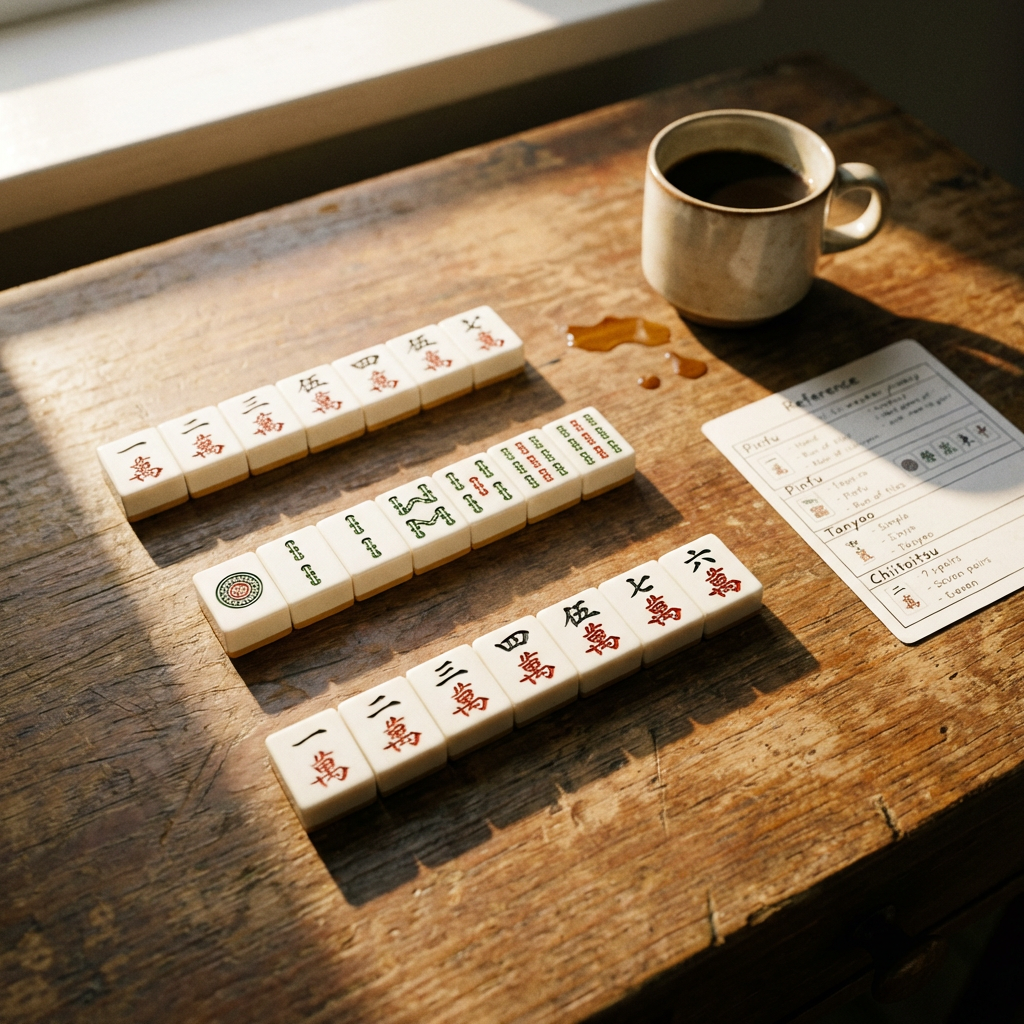
The same sequence (like 3-4-5) in all three suits simultaneously. For example, 3-4-5 of man, 3-4-5 of pin, and 3-4-5 of sou.
San Shoku is one of those yaku that feels like a happy accident when it clicks into place. You'll be building a hand and suddenly realize your sequences line up across all three suits. Worth 2 han closed, 1 han open.
Ittsu - Straight (2 Han)
The sequences 1-2-3, 4-5-6, and 7-8-9 of the same suit. A full "straight" in one suit. Worth 2 han closed, 1 han open.
Ittsu is satisfying to build because it forces you to think in one suit while balancing the rest of your hand. It's a great yaku to aim for when you're dealt a run of tiles in a single suit early.
Toitoi - All Triplets (2 Han)
Your entire hand is made of triplets (or quads), plus a pair. No sequences allowed. Always worth 2 han, and can be won open or closed.
Toitoi pairs naturally with Yakuhai (since you're already building triplets) and can surprise opponents who don't see it coming from your discards. The downside: it's slow to build and requires a lot of specific tiles.

Memory Tricks That Actually Work
Group by Pattern Type, Not by Name
Instead of memorizing yaku as a flat list, think of them in categories: sequence yaku (Pinfu, Iipeiko, Ittsu, San Shoku), triplet yaku (Yakuhai, Toitoi), tile restriction yaku (Tanyao, Chanta), and declaration yaku (Riichi, Tsumo).
When you're building a hand, you're already thinking in sequences or triplets. Grouping yaku by the pattern they reward makes them much easier to spot in real time.
Use Gameplay Repetition, Not Flashcards
A post on r/Mahjong that got nearly 250 upvotes put it best: play enough and "basically anything that feels like it should be a yaku, probably is." That intuition only comes from volume.
Play on Mahjong Soul with the assistant turned on so it tells you when you're in tenpai and which yaku you'd win with. After every winning hand - yours or someone else's - pause and read the yaku breakdown. That 10-second habit is worth more than an hour of flashcard study.
The Tibetan Method for Teaching New Players
This is a well-regarded approach from the riichi community for when you're learning alongside complete beginners. Strip the game down to its core: use only the pin (circle) suit, deal hands of 5 tiles instead of 13, and the goal is simply one group of three plus a pair.
This removes every complexity except the fundamental mechanic of "build groups, win with a complete hand." Once that clicks, you can add a second suit, then more tiles, then yaku one at a time. If you're running a first session for friends who've never played before, the Tibetan method gets everyone actually playing in under 10 minutes.
Riichi Mahjong Yaku Cheat Sheet
Print this out and keep it at the table. In your first games, there's no shame in checking - everyone does it.
| Yaku | Han (Closed) | Han (Open) | Description |
|---|---|---|---|
| Riichi | 1 | - | Declare tenpai with a concealed hand; pay 1000 points |
| Tanyao | 1 | 1 | All tiles are 2-8; no terminals or honors |
| Pinfu | 1 | - | All sequences, non-value pair, two-sided wait |
| Yakuhai | 1 | 1 | Triplet of dragons, seat wind, or round wind |
| Menzen Tsumo | 1 | - | Win by self-draw with a concealed hand |
| Iipeiko | 1 | - | Two identical sequences in the same suit |
| Chanta | 2 | 1 | Terminal or honor in every group and the pair |
| San Shoku Doujun | 2 | 1 | Same sequence in all three suits |
| Ittsu | 2 | 1 | 1-2-3, 4-5-6, 7-8-9 in the same suit |
| Toitoi | 2 | 2 | All triplets (no sequences) |
How Yaku Connect to Scoring
Understanding yaku unlocks about 80% of riichi mahjong, but the other 20% is scoring - and it's what separates players who can play from players who play well.
Each han doubles the base value of a hand (roughly), but there's also a second component called fu that accounts for how the hand was built - whether you won by self-draw, what kind of wait you had, and whether your groups were sequences or triplets. This is why Pinfu hands score differently from Toitoi hands even at the same han count.
The short version: more han = more points, triplets = more fu than sequences, and self-draw wins are generally worth slightly more than ron. For a complete breakdown of how han and fu combine into the point values you'll actually pay and receive, see our guide on understanding riichi scoring and point sticks.
The practical takeaway for now: always know your han count before you declare tenpai. If you can see 2+ han in your hand, you're building something worth winning. If you can only see 1 han from Riichi, you're fine - Riichi alone with dora and Ippatsu can easily reach dealer mangan.
Want to go deeper? The Riichi Wiki yaku list has every yaku in the game with detailed examples. Use it as a reference, not a to-do list. Learn your 10, play your 100 games, then come back and add more.